The Impact of Play on Critical Thinking in Youth Versus Traditional Sports Programs
Updated: Apr 27
“Red light, green light” was a staple of youth soccer programs when I started coaching my children decades ago and remains so today. This type of activity appeals to youth sports administrators because it is easy for both adult coaches and children to understand. It readily demonstrates results to parents when they observe their child learning to start and stop in unison with other children. This post will help you understand what children lose when parents allow adults to control their play.
The best players in soccer can run at near full speed while seemingly keeping the ball attached to their feet. This allows them to advance the ball quickly and immediately capitalize on opportunities created by the opposing team's defense. In theory, “Red light, green light” teaches children to dribble forward quickly when the coach yells “green,” while keeping the ball close so they can stop quickly when the coach yells “red.”
However, as with many aspects of youth sports, children and adults are significantly worse off for participating in this activity. The activity provides confusing feedback, undermining learning. Even worse, it conditions the exact opposite of the behavior that helps children become great players and adults become great coaches.
Children learn by comparing themselves to others. Which child sees that they are outperforming their peers? Is it the child who kicks the ball far out in front of them and gets to the other side of the field first? Or is it the child who barely moves the ball so they can immediately step on it as the coach yells "stop," and then see everyone in front of them still chasing their ball?
The skill that differentiates great players from their peers is their ability to analyze the opposition and improvise successful solutions. How does an activity that focuses the players' eyes on the ball and their brain's attention on listening to the coach’s directions help them achieve future greatness?
The key to becoming a great teacher is learning to optimize conditions that facilitate the transfer of knowledge to students. How does an activity that requires the coach to control every aspect and to provide individual feedback improve their ability to teach?
"(Teaching children) to understand passing is like getting an elephant to fly"
When my two boys learned to play soccer, my wife and I didn’t direct them. Instead, we played games in the backyard in a way that allowed our boys to quickly identify solutions many years before we did. The benefits of this approach, guided discovery, became apparent almost immediately and were evident to the casual observer.
The first image of players clumping around the ball, taken from a video of my younger son Mark’s first U8 soccer season, conforms to our existing beliefs about children’s ability to learn to play. According to US Soccer’s coaching manual at the time, “trying to get them (U6) to understand passing is like getting an elephant to fly.”

The second image directly illustrates that a child's failure to learn is often the result of a poor environment, rather than an innate inability. The only U8 player in the second image from Eric’s first U8 season is making a beeline in the opposite direction from the U6 “Dumbo” with the ball, to get open for a pass. Practicing plays or yelling at kids to get “open” are not effective solutions. Providing an opportunity to play games that allow them to build a model of "open" in their mind is.
The sequence of frames later in the video helps explain the difference in children’s behavior. In the first frame of the sequence, after Eric wins the ball, what appears to be the biggest and most advanced player on the opposing team races to confront him. Eric is two years younger and lacks the athleticism to get past the older player. Therefore, in the second frame, Eric continues to retreat towards his own goal, looking for a chance to turn. In the third frame, he finds the opportunity to turn, and in the final frame of the sequence, he makes a pass.

If you watch the video, the player receiving the pass is, not coincidentally, the same player who is making a beeline away from the ball in the second of the two earlier images. Humans are wired to find experts and imitate their behavior. After learning that he ended up 30 yards away from the ball every time he chased little number four, the best player on the other team adopted a different strategy. When the children on both teams observed “Alpha” players adapting a new behavior, they imitated them, and the entire group improved. Expert teaching is creating situations that quickly transfer information to children, not telling them what to do.
How understanding space impacts mature players
“Walk, walk, walk, look left, look right, walk, walk, walk, jog… bang. Find the space and then exploit it.” – This is a quote from The Athletic article, “Lionel Messi and the art of walking through the World Cup.” The list of top 20 players in distance walked included US goalkeeper Matt Turner, England goalkeeper Jordan Pickford, and Messi. But what is important is not the "walk, walk, walk, walk, walk, walk" part of the sentence. It is instead look "left, look right."
That is why the top 20 list also included: speedster Kylian Mbappe, who scored three goals in the World Cup final; Robert Lewandowski, who, as of 2025, was seventh in the history of the sport in goals scored with almost 700; and Kevin De Bruyne, the great play maker who was at the heart of Man City’s dominant EPL teams. Yet when I looked from the stands or behind the fence at the high school boys and girls from different teams scrimmaging or in drills at the start of the 2026 season, with a few notable exceptions, the heads of players on over ten different teams were glued to the small space near the ball the entire time.
I’ll build on the contrast between written learning and guided discovery of space at the U8 level discussed earlier and examine how it manifests at the high school level. The images are from a goal Eric scored in seven seconds off an opposing team's kickoff. The focus here is on the level of anticipation and paying attention to changes in space. Moments before play, anticipation ranges from the two players circled in red, already in motion, to the player in yellow, standing flatfooted with his hands on his hips.

The second image shows the relative movement of each player in the frame in the time Eric covered 15 yards beyond the center line. The players (and referee) underlined in blue moved less than two yards, those underlined in yellow about 5 yards, and those underlined in red about ten yards. Three of the five deepest outfield players on the opposing team never moved more than two yards from the time the ball was put in play to when it crossed the goal line.

While the high school coach is, to some extent, culpable, it's important to remember that most of these players spent their youth playing for club teams and training year-round. Despite claims to parents about their focus on development, these coaches were mainly concerned with teaching players robotic strategies to win the next game rather than helping them think critically and learn from mistakes.
For those dismissing this as poor high school players, Eric’s team was the state champion, and one of his teammates was a 3-time US Youth Soccer national champion and a former member of the US Boys' National Team pool. If you would like to go one step deeper, I have an additional analysis of another game that features two pairs of similar goals and more clearly illustrates how the more successful players differentiate themselves by better utilizing space.
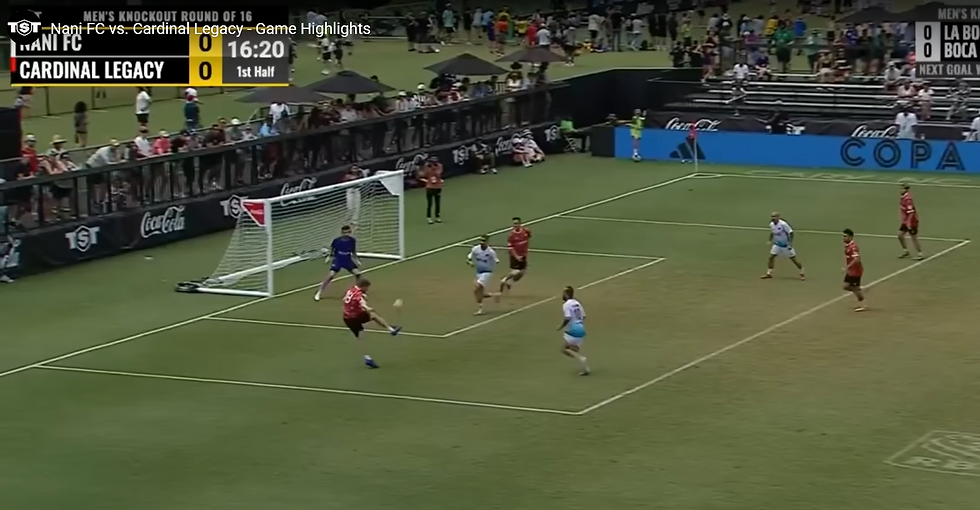
Finally, defenders at every level often appear weak in highlight reels. Above is Eric, just as wide open, scoring the opening goal this summer against a team put together by Portuguese legend Luis Nani for a 7 v 7 tournament that offered a million dollars in prize money to the winner. The starting lineup featured some of Nani’s recently retired national team teammates and from Portugal's Futsal national team. The player Eric caught ball watching was Ricardinho, regarded by many as one of the best futsal players of all time.
The reality is that decision-making becomes increasingly critical as one advances to higher levels, yet our youth programs deprive our children of the opportunity to develop this skill. Instead of play developing children's brains to succeed later in life, adults steal children's playtime to stoke their egos by associating themselves with meaningless teams focused on winning insignificant games. Read on to understand other reasons why so few children come close to reaching their potential, and most are now quitting soccer and other youth sports by age ten.

